December 2025
Developing a “Leaders Teach” approach in a Supreme Audit Institution
The United States Government Accountability Office (GAO) is committed to providing nonpartisan, objective, professional, and reliable information and recommendations, as well as program and technical assistance, to support the United States Congress. Our work has led to a 6-year average return of $123 for every $1 invested in our agency. For 20 years, our Learning Center’s Adjunct Faculty Program has been a cornerstone of these efforts. In this program, well-trained analysts and auditors teach our staff to strengthen their audit skills, deepen their knowledge, and develop new technical abilities. I appreciate INTOSAI selecting the Adjunct Faculty Program for this case study and am pleased to share the results of the program’s success fostering excellent professional development for GAO staff.
Gene L. Dodaro
COMPTROLLER GENERAL OF THE UNITED STATES
The INTOSAI Capacity Building Committee
In 2016, the Governing Board of the International Organization of Supreme Audit Institutions (INTOSAI) established the Task Force on INTOSAI Auditor Professionalization
(TFIAP) to conduct development work on the concepts of auditor competence. The TFIAP was led by the Capacity Building Committee (CBC), one of four INTOSAI Goal Committees that assist the Government Board in implementing INTOSAI’s goal and objectives. The CBC is INTOSAI’s advocate and custodian for SAI capacity development and leads INTOSAI efforts under Goal 2 – capacity building.
In 2023, the TFIAP members planned to compile a series of case studies on professionalization issues from Supreme Audit Institutions (SAIs) and selected the U.S. Government Accountability Office’s (GAO) Adjunct Faculty Program as a case study. This document describes GAO’s Adjunct Faculty Program, including efforts to recruit, train, and support instructors.
GAO is proud to share details of this program with the INTOSAI CBC community and believes that this approach can help SAIs increase their capacity development. GAO welcomes feedback, suggestions, and inquiries on the program from other SAIs.
The Government Accountablity Office
GAO is an independent, nonpartisan agency in the legislative branch of the United States federal government. Commonly known as the investigative arm of the Congress or the “congressional watchdog,” GAO examines how taxpayer dollars are spent and advises policymakers and executive branch agency heads on ways to make government work more efficiently.
GAO’s mission is to support the Congress in meeting its constitutional responsibilities and help improve the performance and ensure the accountability of the federal government for the benefit of the American people. GAO’s three mission core values—accountability, integrity, and reliability—form the basis for all its work. These mission values work in concert with GAO’s three core people values—that its staff are valued, respected, and treated fairly—to create a synergy that is essential for GAO to achieve its mission.
GAO was established in 1921, when the Budget and Accounting Act transferred auditing responsibilities, accounting, and claims functions from the Treasury Department (in the executive branch) to this new agency. GAO was created because federal financial management was in disarray after World War I. Wartime spending had driven up the national debt, and the Congress saw that it needed more information and better control over expenditures. The act made GAO independent of the executive branch and gave it a broad mandate to investigate how federal dollars are spent. GAO’s Comptroller General is appointed to a 15-year term.
GAO has 15 functional mission teams of analysts, financial auditors, and specialists to support its three external strategic goals—addressing challenges to the well-being and financial security of the American people; helping Congress respond to changing security threats and challenges of global interdependence; and helping transform the federal government to address national challenges. These mission teams focus on topics such as contracting and procurement; national security and intelligence; the nation’s care for disadvantaged populations; stewardship and accountability of financial resources; regulatory oversight of financial markets; waste, fraud and abuse; federal healthcare; justice, security, and emergency preparedness; information technology and cyber security; U.S. foreign policy and international economic interests; the nation’s land and water resources; the nation’s physical infrastructure; science and technology; and the nation’s fiscal health and the federal workforce.
In addition, GAO has several staff and administrative offices that work to support the agency’s mission teams, the Congress, and the American people. For example, GAO’s Office of General Counsel provides legal counsel to the entire agency and provides dedicated attorneys to each mission team who advise staff during the audit and reporting processes.

Source: background image | GAO
GAO’s Learning Culture
GAO has built a culture of learning based on requirements for analysts and auditors to obtain professional education credits. Specifically, to meet GAO’s Government Auditing Standards (the “Yellow Book”) GAO’s analyst and auditor staff must complete 80 hours of continuing education credits (called Continuing Professional Education credits or “CPE”) in each 2-year cycle, including 24 credits directly related to the government environment, government auditing, or the specific environment in which the entity operates. If analyst and auditor staff do not complete these requirements, GAO does not permit staff to perform Yellow Book audits until they have earned enough CPE credits to bring them into compliance.
 “The continuing competence of the audit organization’s personnel depends, in part, on an appropriate level of CPE so that auditors maintain the knowledge, skills, and abilities necessary to conduct the
GAGAS engagement.”
-Government Auditing Standards, 2018 Revision
To help GAO’s analyst and auditor staff meet these requirements, GAO’s training center—called the “Learning Center”—develops in-person, virtual, and hybrid courses. The courses vary in length from quick refreshers to in-depth sessions. The Learning Center also produces e-learnings, training materials, tip sheets, and more. In fiscal year 2024, the Learning Center sponsored almost 800 class sessions. While Learning Center staff and contractors teach some classes, more than half of the classes are taught by certified instructors from the Adjunct Faculty Program. New analyst staff participate in the Professional Development Program1 (PDP) where Adjunct Faculty Instructors teach them 14 classes on audit skills over the course of 2 years.
Teaching helps me to ensure I stay up-to-date on our agency’s priorities and messages and allows me to meet new staff and staff from other parts of the organization.
Furthermore, I find having to present concepts and materials to others helps me practice ways of delivering information and seeing how clear I am vs. how clear I think I am.
~Certified Instructor
Leaders-as-Teachers Program
“Docendo discimus.” When we teach, we learn. Supreme Audit Institutions can benefit greatly from developing and effectively maintaining a Leaders-as-Teachers program. Under such a program, experienced staff step into the classroom (virtual or in-person) to teach newer staff how to perform key audit tasks. Effective teaching by experienced auditors who have “been there and done that” helps staff to learn, remember, and, most importantly, apply the course material.
Building on learning principles that adults learn best when they are interested and involved, instructors facilitate discussion of the material through thoughtful, probing questions. Instructors also teach using dynamic, on-point lectures, vivid language, illustrative examples, and storytelling with messages that stick. As a result, our staff become engaged learners who are excited to learn more about the topic.
In a Leaders-as-Teachers program, instructors improve their skills in collaboration, influence, and inclusiveness. New staff taking courses feel more engaged in the work and learn audit-specific skills and knowledge. Meanwhile, the auditing entity benefits from the organizational growth that comes from fostering a culture of learning.2 Audit entities also benefit because their training centers do not need to detail staff away from audit work for long periods of time or seek outside contract support to teach the classes.
2 Leaders as Teachers, Engaging Employees in High-Performance Learning, The Training Associates in cooperation with The Association for Talent Development Research.
 GAO’s Adjunct Faculty Program
 GAO’s Adjunct Faculty Program
GAO has had a Leaders-as-Teachers program, or “Adjunct Faculty Program,” in place since 2006. Under this program, GAO has certified more than 200 staff as instructors, drawn from the analyst, auditor, and operations support communities. Instructors teach classes for our approximately 2,500 analyst staff on topics ranging from core audit skills such as evaluating internal controls and developing report messages, to navigating difficult meeting situations and providing effective feedback. Instructors also teach courses for our analyst and additional 1,000 non-analyst staff on leadership; applied computer skills; research methods; and other cross-cutting issues. Typically, instructors teach a particular class 2 or 3 times a year,
balancing teaching with their assigned work. Unlike a train-the-trainer program in which instructors learn how to teach specific content, instructors come to the Adjunct Faculty Program with previously developed expertise on a particular subject matter. In the instructor training (described below) they focus on becoming proficient in adult learning theories and teaching techniques that they can apply in multiple courses.
The Adjunct Faculty Program allows GAO to achieve costs savings since it helps analysts and auditors to fulfill their CPE requirements without having to bring in outside contract instructors. The Adjunct Faculty Program allows GAO to achieve costs savings since it helps analysts and auditors to fulfill their CPE requirements without having to bring in outside contract instructors. The Adjunct Faculty Program has contributed to GAO’s learning culture and the agency’s results demonstrate the positive effects of this learning culture. GAO has ranked high in the Partnership for Public Service’s3 Best Places to Work listings since the Partnership’s program started in 2005. For example, for 5 years running GAO has ranked the highest for Midsized Federal Agencies as the best place to work. In 2025, Forbes also recognized GAO for being one of America’s 77 best employers for the last 10 years. This excellence is also reflected in our retention data—in fiscal year4 2024, GAO retained 95 percent of its staff, or 97 percent when excluding retirements.
GAO’s Adjunct Faculty Programs is one of the pillars of our continual learning culture and contributes to GAO’s high retention rates. The exchange between students and instructors enriches both by keeping instructors’ skills sharp and developing and enhancing the skills of the students.
~Orice Brown Williams, GAO Chief Operating Officer
Recruiting Staff to Serve as Instructors
Open Season
To recruit GAO staff to be instructors, the Adjunct Faculty Program Manager conducts a yearly “Open Season” process. In this process, Learning Center Course Managers determine how many classes of each course to offer, often based on prior year needs. They then identify the number of new instructors they will need to teach in the next fiscal year and share their needs with the Adjunct Faculty Program Manager. The Adjunct Faculty Program Manager then issues an agency-wide notice that details the courses with openings for new instructors.
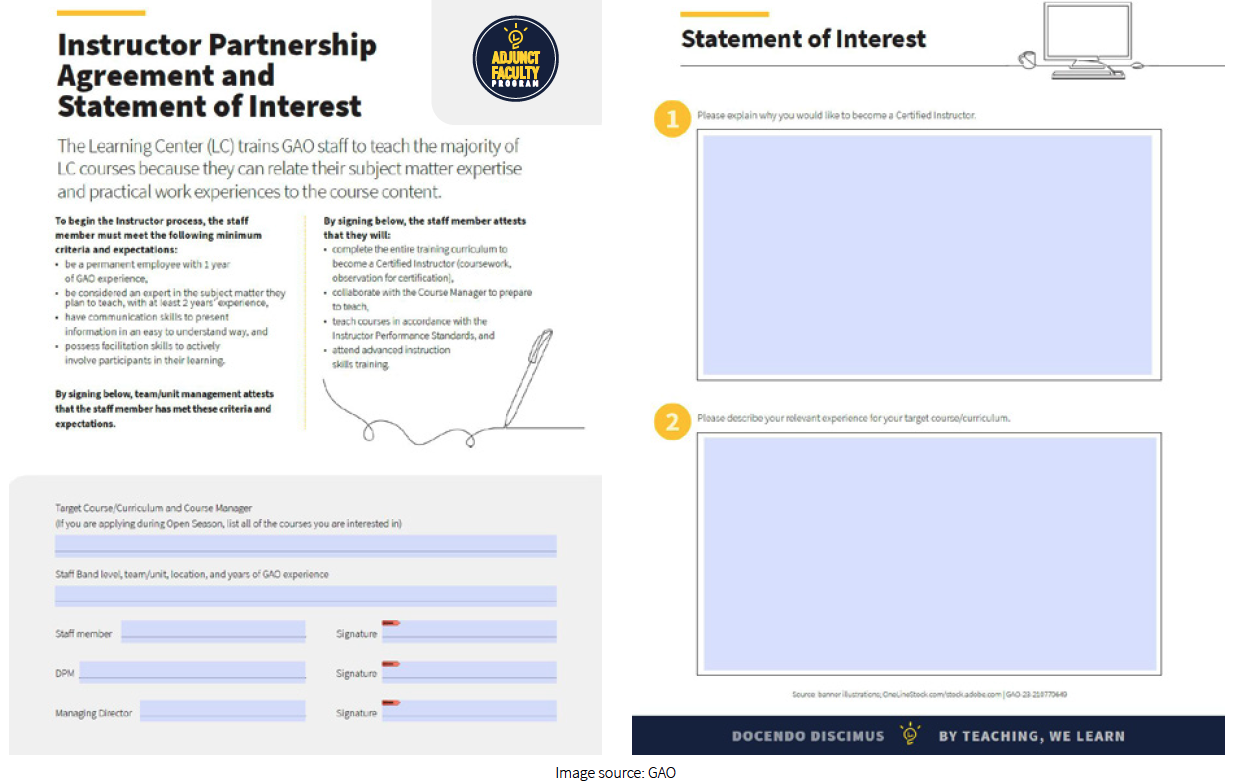
Interested staff apply by completing a “Partnership Agreement and Statement of Interest” in which unit management attests that the employee has at least 2 years of subject matter expertise, has communication skills to present information in an easy-to-understand manner, and possesses facilitation skills to actively involve participants in their learning. Meanwhile, the staff members attest that they will complete the coursework and certification process, collaborate with the Course Manager, teach courses in accordance with performance standards, and continue to improve their teaching skills.
 INSIGHT: The Partnership Agreement is important because it helps ensure that the unit management is committed to dedicating the employees’ time to the stewardship effort and the staff member has the backing of management in embarking on the training program.
Staff members also complete a “Statement of Interest” in which they explain why they would like to become a Certified Instructor and describe their relevant experience for the course they wish to teach.
INSIGHT: The Statement of Interest is important because it demonstrates to management the prospective instructor’s commitment to teaching and it encourages instructors to think from the very beginning about why they want to teach. With this grounding, they are more receptive to putting in the hard work to improve their teaching.
In the Open Season process, the Adjunct Faculty Program typically receives more applicants than available openings. Course managers review the applications and determine who to select. Selected staff then work with the Program Manager to sign up for the foundational training. The Program Manager contacts staff who were not selected and encourages them to apply again at a future date.
Expert Track
While Open Season serves to supply most of the instructors that Course Managers need to teach courses, there are some courses for which extensive prior expertise is required. For example, teaching a class on research methodology requires an instructor with a doctorate on the topic. Or a law course may require a GAO attorney to teach. In these special cases, the Adjunct Faculty Program allows these staff to bypass the Open Season and apply directly to the program, become Provisional Instructors, and sign up for the instruction training. Staff on the expert track still fill out a Partnership Agreement and Statement of Intent and get approval.
INSIGHT: About 72 percent of GAO analysts have advanced degrees in their field of study. Because our work spans the full range of government programs and spending, we must hire and retain a multidisciplinary staff. GAO staff have wide-ranging expertise from many academic fields, including engineering, biology, computer science, cybersecurity, public policy, accounting, law, physics, economics, criminal justice, finance, business, and nursing, among others.Instructor Call
In addition to the Open Season, Course Managers have another way of recruiting instructors to teach classes, particularly if they would prefer to have experienced instructors teach the course. In this case, the Course Manager can issue an “Instructor Call.” The Instructor Call is advertised in a monthly Instructor Newsletter and lists the number of openings as well as desired experience and grade level. Then, Certified Instructors who have already completed the training and observation program apply to teach the class. They may be motivated by wanting to teach another course or else they may want to switch the course they teach. For example, maybe they have taught a course on referencing fundamentals for 5 years and now would like to switch to teach a course on report writing and reviewing strategies.
Leveraging adjunct faculty instructors to develop and enhance auditor skillsets provides a unique opportunity for new staff to access a wealth of organizational knowledge and experience. By adding personal examples and perspectives from the audit trail, instructors can offer new staff real-world scenarios to anchor their
understanding of key concepts and objectives from the trainings. It provides new staff with a point of reference to reflect on when faced with challenges in their own work.
~Professional Development Program Managing Director
Training Instructors to Teach and Certifying Instructors
Foundational Instructor Training
To prepare new staff to teach, the Adjunct Faculty Program requires them to take an “Instruction Theory, Technique, and Practice” course offered over three consecutive weeks. This course is taught by the Adjunct Faculty Program Manager. The first section focuses on adult learning theory—how adults learn differently than children.5 The second section surveys techniques for teaching, including how to teach in a virtual environment and manage the virtual platform. The course is anchored on four performance standards: setting the stage
for effective learning, presenting information in easy-to-understand manner, facilitating participation so that participants are actively involved in their learning, and managing classroom challenges with poise.6
The next week, participants conduct a “dry run” in which they practice operating the virtual classroom and working with the producer to prepare to teach. Then, the participants try out their teaching skills in a practicum session in which they teach a 15-minute segment from their “target class.” They receive
immediate feedback from their peers in the session and from the Adjunct Faculty Program Manager. The feedback is in the form of “glows” that highlight what the instructor did well and “grows” that highlight areas for instructor improvement. The Adjunct Faculty Program Manager also adds techniques to try when the new instructors start teaching. The participants view a recording of their session and send the Adjunct Faculty Program Manager their reflections on the session.
I teach to create an environment where staff can learn useful information to do their
jobs better. I enjoy trying to establish environments where there is interaction among
the participants—it is satisfying to set the stage and then sort of step back, providing
light guidance as the participants talk among themselves and share information.
~Certified Instructor
Instructor Initial Certification
After completing the training, within the next year, new instructors:
- observe an experienced instructor teach the target class and take notes on the teaching techniques they see in use,
- teach the class once or twice,
- are observed by the Adjunct Faculty Program Manager or designee for certification based on the performance standards, and
- participate in a 1-hour coaching and feedback session with the Adjunct Faculty Program Manager or designee.
After this observation session, new instructors are either certified or observed again to demonstrate the coaching in action. Once certified, instructors commit to teaching at least twice a year to maintain their active status.
GAO offers two initial certifications—for the in-person and virtual classrooms.
INSIGHT: The foundational training does not end when class sessions end. Rather, the certification process serves as the capstone of the training program. From a learning perspective, the Adjunct Faculty Program Manager or designee observes the instructor’s application of the theories and techniques in the live classroom setting, usually months later. This is a form of “spaced learning” in which instructors have to reach back to remember what they have learned tobe able to apply it. Following their observation, the instructor fills out a “Post-instruction Reflection Tool” where they can document their lessons learned. Then, in the following coaching and feedback session, the Program Manager or designee highlights where the instructor successfully implemented teaching techniques, points out opportunities for improvement, and reminds them of techniques to try the next time they teach.
Senior Instructor Certification
Experienced instructors can apply for certification as a Senior Instructor. To qualify for this certification, Certified Instructors must meet the following requirements:
- Have taught at least 100 hours at GAO
- Have taught at least twice in each of the last 2 years
- Have received an endorsement from their Course Manager
- Complete three Advanced Instruction Curriculum courses (see below)
- Be observed teaching, complete a self-reflection, then receive a coaching and feedback session.
Teaching has been one of the most satisfying aspects
of my career at GAO because it allows me to share with new employees what I have learned over three decades. And in that way, I’m giving back to GAO and the broader accountability community while connecting with a new generation of auditors and analysts.
~Certified Instructor
INSIGHT: The Senior Instructor Program provides a goal for instructors who stay active in the program and rewards accomplishment. When instructors stay in the program for a long period of time, they get valuable teaching experience and improve their skills. When Senior Instructors introduce themselves in their classes, their senior status adds to their credibility.
Check-in Observations
Three years after their certification, Instructors are prompted to schedule a Check-in Observation. The Adjunct Faculty Program Manager or designee observes them teaching, they complete a self-reflection tool and then take part in a coaching and feedback session. This repeats every three years.
INSIGHT: The Check-in Observation is an opportunity for the Adjunct Faculty Program to provide instructors with tips and tricks to help them improve their teaching.
Ongoing Supporting for Instructors
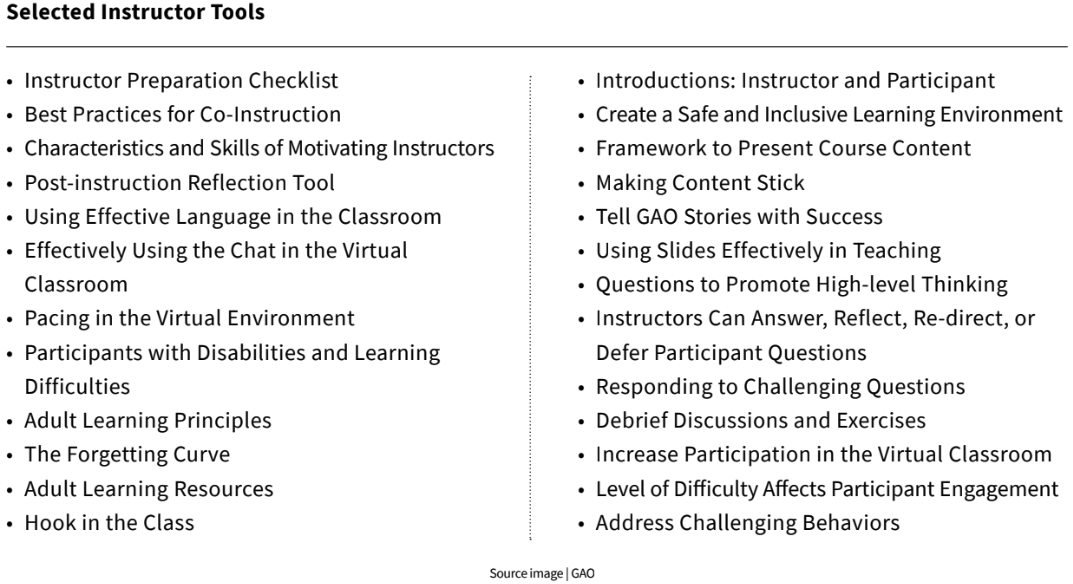
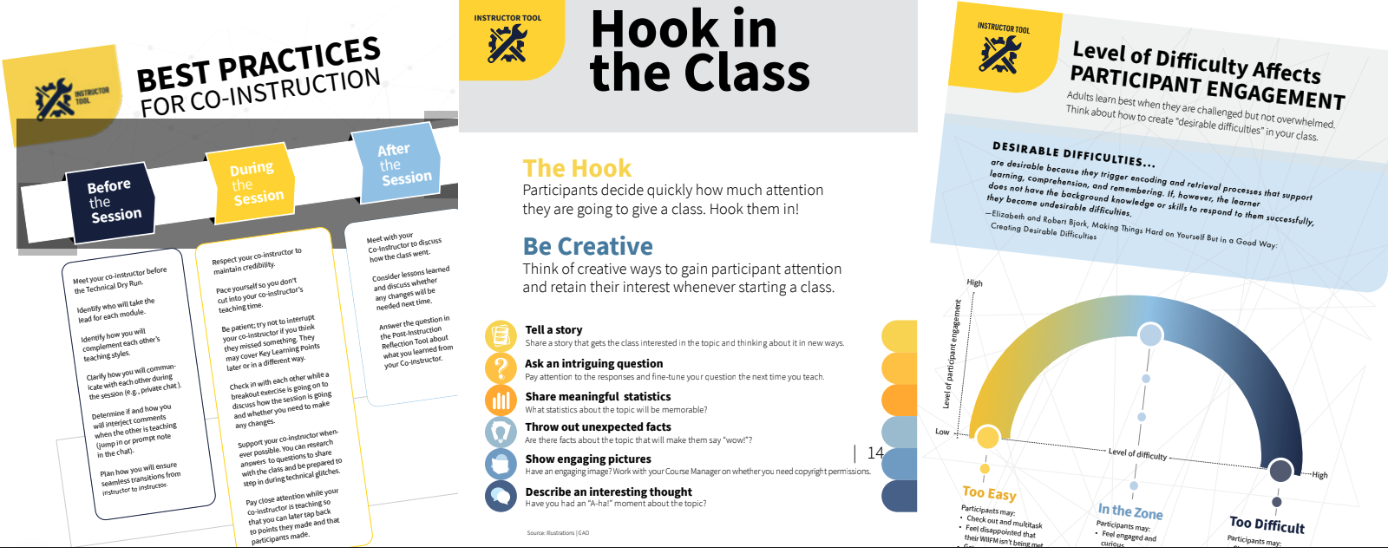
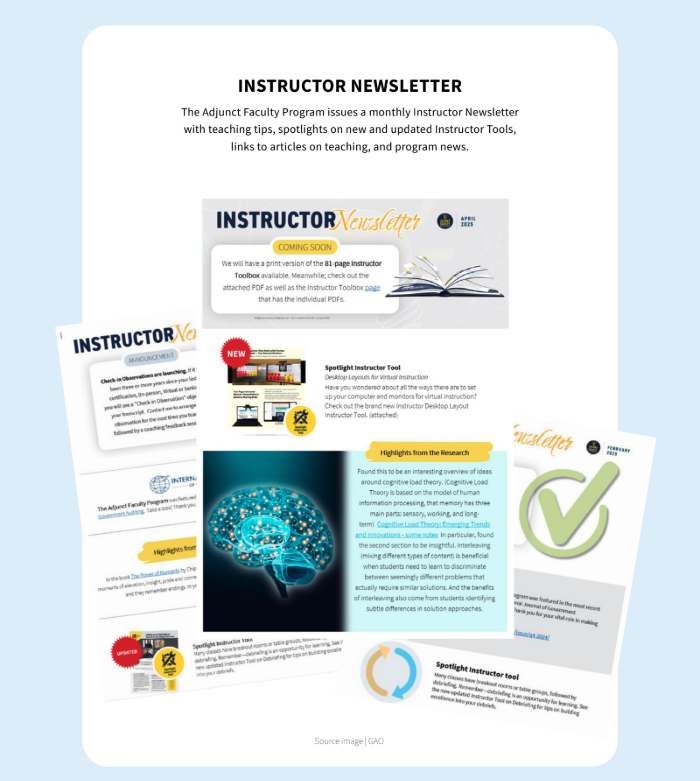
As instructors typically teach 2 or 3 times a year, it is critical that the Adjunct Faculty Program provides ongoing support for instructors. This comes in the form of participant evaluations, 1-hour courses on adult learning theories and techniques, a “lunch-and-learn” series, an extensive collection of tip sheets, and a monthly newsletter.
Evaluations
Course Managers and the Program Manager review class evaluations submitted by participants and Course Managers share them with instructors. The evaluations help the instructors learn what they are doing well and where they can improve. Depending on the evaluations, instructors may need additional coaching or training before being given an opportunity to teach again.
Advanced Instruction Curriculum
Instructors can take classes that help them to deepen their knowledge of adult learning theory and sharpen their teaching techniques. Topics for these 1-hour sessions include facilitation techniques, storytelling, effective debriefing, and using evaluations to improve teaching.
INSIGHT: The Advanced Instruction Curriculum classes serve as continual learning for the instructors. In addition, the instructors get to know each other in the classes forming a community of practice.
GAO has a range of guidance documents to help analysts carry out their work. These documents, while vital to ensuring consistently quality work, don’t always capture the myriad nuances involved at the heart of conducting audit work. Adjunct Faculty instructors breathe life into documents like the Yellow Book, showing how we can internalize their provisions as we grow our knowledge and skills as analysts and put them into practice in our day-to-day work.
~Professional Development Program Managing Director

Recognizing and Rewarding Instructors
Awards Ceremony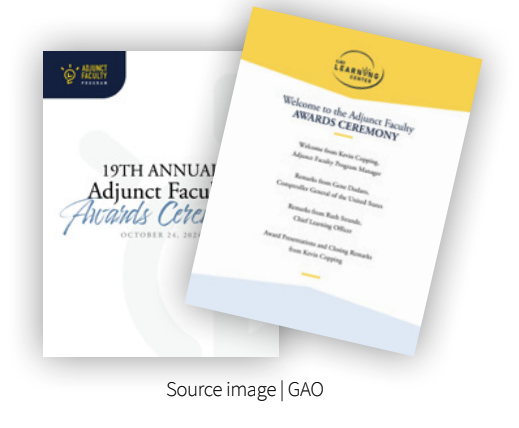
The Learning Center hosts an annual GAO-wide awards ceremony, attended by the Comptroller General and other executive staff, to recognize instructors who were certified during the year and to give the following awards. Learning Center management, Course Managers and the Adjunct Faculty Program Manager work together to provide the following awards:
Instructor Excellence Award
This award goes to Certified Instructors who have regularly demonstrated excellence in instruction.
Organizational Learning Champion Award and Appreciation Award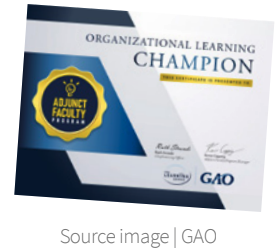
These awards go to Instructors, Subject Matter Experts, and other GAO staff who have been instrumental in significantly improving the quality, content, or impact of learning at GAO.
CPE Credits for Teaching
When instructors teach classes that qualify for CPEs, the instructor can claim three times the number of CPE as the class, reflecting preparation and teaching time.
Instructor Self-assessment
GAO staff receive performance reviews each fiscal year. Instructors can highlight their teaching experience in their self-assessments that they complete as part of this process in support of GAO’s “Working with Others” performance competency.
Teaching actually terrifies me and that feeling has never eased, even as I close in on my Senior Instructor certification. Teaching is one of the more challenging agency stewardship activities I am involved with at GAO. But teaching is what helps our organization maintain its reputation.
Without instructors who have experienced performance auditing, how would our colleagues know what to expect and assess for themselves whether what they are experiencing or seeing on the audit trail is “typical?
Being a certified instructor gives me confidence in the classroom and on the audit trail. In turn, having a solid foundation of knowledge and acknowledgment of my experience inside and outside the classroom, allows me to go a step deeper in challenging my colleagues to learn and share their experiences.
Finally, being a certified instructor provides regular practice in presenting information, listening to others, and connecting people and ideas. What could be any better?
~Certified Instructor
Tips for Setting up an Adjunct Faculty Program
- In developing the program, GAO learned that it is important to get upper management buy-in to provide staffing resources that help ensure the program’s success. Without dedicated staff time, there is no Adjunct Faculty Program. The Partnership Agreement has been important tools in supporting this effort, documenting management agreement that the staff member has the experience and skills to teach and that the staff member’s time will be well-spent teaching.
- In the beginning, the program required instructors to become recertified every 3 years. In the intervening years, this effort fell away. In 2025 the Adjunct Faculty Program re-instated a quality control observation, the Check-in Observation referenced above. This observation allows the Adjunct Faculty Program Manager or designee to help ensure that instructors are providing quality instruction and to refresh instructors on teaching tips and techniques.
- An Adjunct Faculty Program of the scale of GAO’s program requires a Program Manager who can devote most of their time to management and administration of the program, to include instruction and instructor observations. For a smaller program, this role could be combined with other duties.
- To implement an Adjunct Faculty Program, SAIs should consider how to “scale” the effort to meet their needs. Specifically, they should identify their training needs and the number of Adjunct Faculty instructors needed to meet the demand. While GAO has more than 200 instructors, a smaller SAI could create a cadre of 10-20 instructors teaching classes or partner with other SAIs in the region.
GAO’s Adjunct Faculty Program represents more than a singular talent development activity—it embodies the essence of a systems-based learning organization. Anchored on a shared vision of continual learning and improvement, the instructors are empowered by executive leadership and agency-wide support to transfer their knowledge and experience across functional, operational, and hierarchical lines. Through their instruction and continual development as instructors, they also deepen their own expertise and mastery of their profession by enhancing their communications skills and keeping current with the latest best practices and policies. As highlighted in the quotes in this case study, instructors and leaders reference the impact the program has had on organizational talent development, retention, and succession. Through this program, GAO’s workforce is able to rapidly address knowledge and skills gaps and adapt to the ever-changing landscape of government accountability.
~GAO Chief Learning Officer Ruth Strande
Conclusion
The GAO Adjunct Faculty Program has been a tremendous resource for the agency. Over the course of 20 years, the program has grown in size from a handful of instructors to hundreds. The program has also grown in sophistication with a wide variety of tools and resources to support instructors in teaching. Developing the program took long-term planning, vision, and hard work.
Today the program helps GAO to effectively develop staff members in building their audit skills. Certified instructors benefit from using the instructor skillset to help participants to learn, remember and apply the material. At the same time, the instructors benefit by deepening their knowledge of agency procedures and taking on a new challenge in their mid-career years.
Are you interested in setting up an Adjunct Faculty Program at your SAI? Would you like to see a more detailed program description? Contact the U.S. Government Accountability Office by emailing media@gao.gov.

Source Image: GAO building; demerzel21/stock.adobe.com | GAO-25-1017310053