
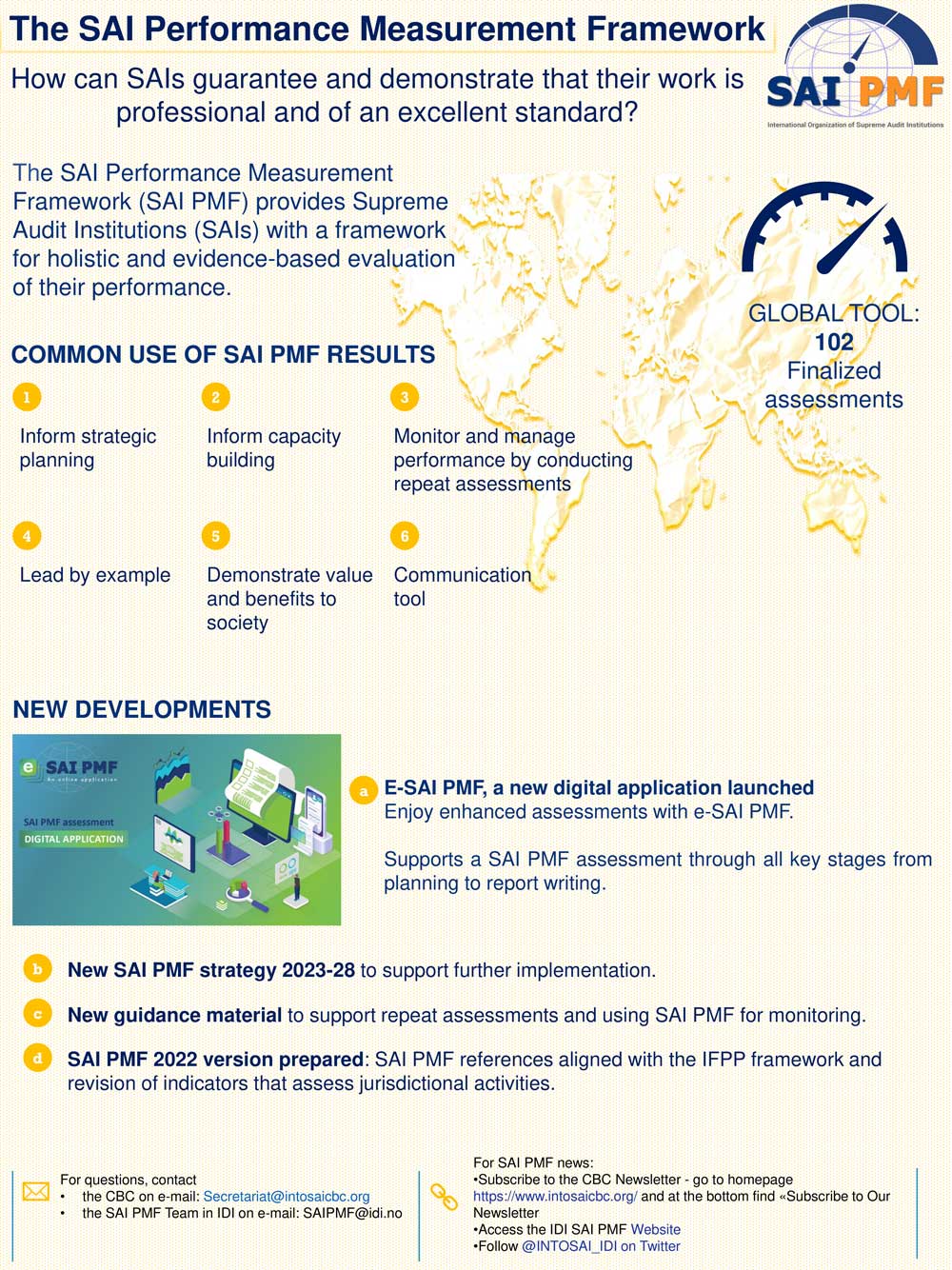
SAI PMF
The SAI Performance Measurement Framework (SAI PMF) is an international framework for self, peer, or external assessment of a SAI’s performance against the International Standards of Supreme Audit Institutions (ISSAIs) and other established international good practices that was adopted by INTOSAI in 2016.
The SAI PMF enables SAIs to sustainably improve their performance and impact, thereby contributing to the INTOSAI’s mission of fostering continuous improvement in SAI performance. The SAI PMF is a valuable tool for all SAIs, regardless of development level – the tool identifies performance variations in a meaningful way, and assists the SAI in understanding the causes of strong and weak performance. Furthermore, the tool enables SAIs to confidently engage internally and externally regarding their future relevance and value-add, demonstrating its commitment to transform and acceptance of the need to adhere to the highest international standards.
By the end of 2020, a total of 68 SAI PMF assessments have been completed, with 50 assessments in process and the SAI PMF has decisively helped many SAIs to improve their performance.
The CBC is the governance lead for the global roll-out of SAI PMF, and the IDI is the operational lead. In order to provide for strategic advice, the CBC has established a SAI PMF Independent Advisory Group (IAG) consisting of volunteer donors, SAIs and INTOSAI bodies with knowledge of and experience in the SAI PMF. The IAG provides strategic advice and recommendations to support the CBC and IDI in their efforts to implement the SAI PMF Strategy.
SAI PMF Implementation Strategy
SAI PMF Strategy 2023-2028 (Oct 2022)
Also see
About SAI PMF
- The SAI PMF can be applied in all types of SAIs, regardless of SAI models, mandate, national context and development level, so long as the SAI considers the ISSAIs as a relevant benchmark.
- The SAI PMF examines holistically both the SAI’s audit and non-audit functions in relation to its legal foundation and environment, identifying interdependencies between different aspects and root causes of SAI performance, thereby providing a strong basis for comprehensively assessing the SAI’s needs, informing its’ strategic and capacity development planning, and enabling tracking of progress over time.
- The SAI PMF is a valuable tool for all SAIs, regardless of development level, to demonstrate to stakeholders the extent to which the SAI contributes to strengthening public financial management, promoting good governance, fostering transparency and accountability, and fighting corruption, and ultimately the SAIs’ commitment to increasing their value and benefits to society.
- For developing country SAIs, the SAI PMF is an invaluable tool for obtaining and maintaining support for its capacity development efforts by showing their commitment to transform, acceptance of the need to adhere to the highest international standards, and the SAIs’ commitment to increasing their value and benefits to society.
Ongoing Activities
By the end of 2020, a total of 68 SAI PMF assessments have been completed, with 50 assessments in process and the SAI PMF has decisively helped many SAIs to improve their performance.
Meetings - Agendas/Minutes
Documentation - Progress reports
Members of the SAI PMF Independent Advisory Group
Contact information
For more information on SAI PMF, please contact Mr Cobus Botes, SAI South Africa: cobusb@agsa.co.za
News

Word from the CBC Chair
Guidance to SAIs in times of crisis The outbreak of the coronavirus pandemic has resulted in a variety extraordinary responses by our respective governments in order to cope with the global crisis. At the same time supreme audit institutions are grappling how...

Peer review as a looking glass
by Karol Mitrík, SAO SR president (SAI of Slovakia) The public administrations all across the globe are increasingly challenged by the society and its stakeholders to demonstrate and improve their value for sustainable development. SAIs serve as important pillars of...

Accountability in a time of crisis
How Supreme Audit Institutions and development partners can learn from previous crises and ensure effective responses to Covid-19 in developing countries. The Covid-19 crisis is global and has massive impact on all countries in areas such as public health, employment,...
AFROSAI-E Bulletin now available
The first issue of the AFROSAI-E Bulletin April 2020 is now available, and brings up the Secretariat's strive to continue its support to the AFROSAI-E members in this time of crisis, as well as other topics - enjoy this interesting read! Please find it...
A word from the CBC Chair
Dear CBC members and observers, I trust this communiqué finds you all in good health and positive about us jointly overcoming these very difficult times. I am writing to you with regards to the 2020 CBC-IDSC contiguous meetings scheduled to be held in Jamaica from...
Coronavirus: How should SAIs respond?
The global coronavirus pandemic is leaving us all stunned. Each day we hear of new countries having to close borders, place citizens under lockdown, and launch major new publicly funded initiatives to ensure businesses survive and people are fed. It is easy to feel...

A short note in times of Covid-19
Greetings from the CBC leadership and secretariat with hopes that our members and stakeholders are keeping healthy in these times of the Covid-19. Please know that the work of CBC continues (although from home offices) and we will do our utmost to maintain the pace of...

Welcome to join next ACCC webinar 18 March, led by SAI Somalia
OAG Somalia’s historic financial and compliance audits: First hand experiences of delivering audits in complex and challenging contexts 18 March 2020, at 2 pm Somalia time. In 2019 the Office of the Auditor General of Somalia for the first time audited the financial...
New open learning platform now available to INTOSAI community
ECAdemy, the new open learning platform of the European Court of Auditors (ECA), is now operational and available to the INTOSAI community ECAdemy comes in response to several requests from SAIs and other organisations that are interested in e-learning opportunities....
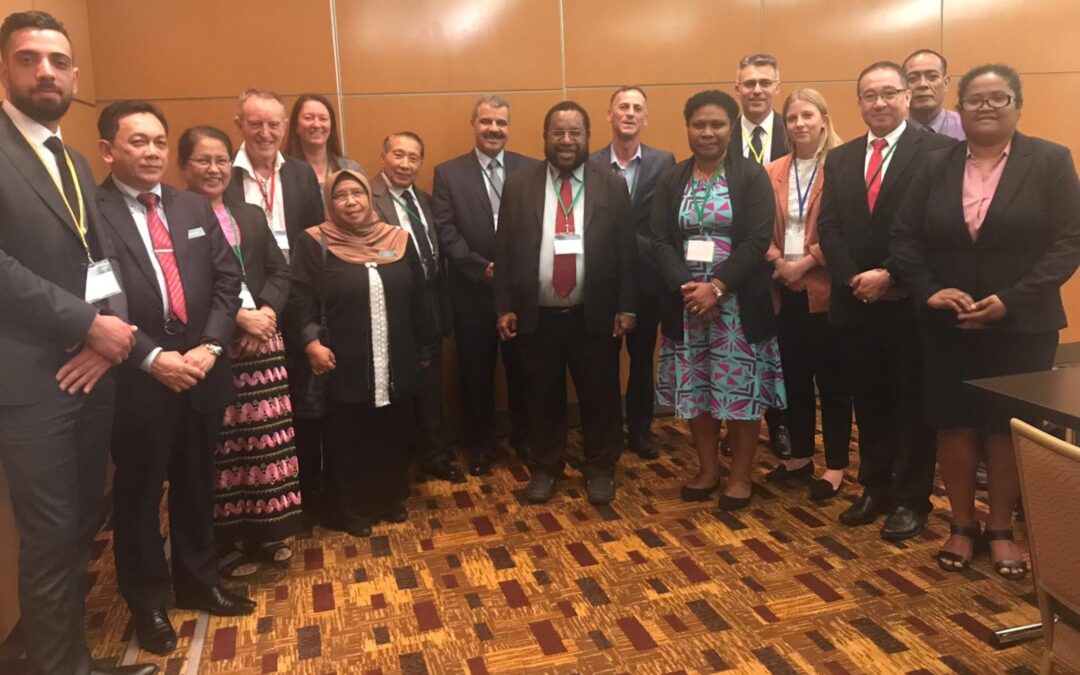
ACCC workshop in Kuala Lumpur
On December 12-13, the Swedish National Audit Office (SNAO) organized a workshop for supreme audit insitiutions in complex and chllenging contexts. The workshop took place back-to-back with a conference held by IFAC (International Federation of Accountants) in Kuala...